
I’ll be sharing with you excerpts from volume 12 in my series Secret History of the Witches. The title of this book is The Sorcery Charge, looks mainly at the 1300s. The chapter I’m talking about here is called “Women, Power and Danger.” This is an ad hoc summary;annotation will follow in the final text version. If you’d like to support this independent (insurgent) scholarship and speed up production of these books, you can become a paid subscriber to my substack or contribute via patreon.com/maxdashu . Below is a somewhat edited transcription of the audio version.
This chapter is actually the last in the volume titled The Sorcery Charge. I’m looking at the sexual politics of witchcraft in Western European society, primarily, in this chapter, in this volume. I look at the sexual politics of witchcraft accusations and the vulnerability of women to them, but also the power that’s attributed to women and that women themselves saw in resorting to spiritual means where all other social structures were designed to subjugate them. Everything from marriage law, inheritance, sexual behavior codes, income levels, paid work or unpaid work in the case of most females.
Church and state used the sorcery accusation to subjugate women. And they hurled it at every female sphere of power, including the home. If a woman manages to prevail against the disadvantages and injuries that she faced in marriage, if she exercised power in life she must be a witch or have turned to one for assistance. The witches who were women’s resort in battery or desertion, who provided contraceptive methods or love charms or medicines for colicky babies—these women were tortured and burned.
From the late 1300s and increasingly through the next century, accusations of witchcraft became all the ammunition that was needed to destroy a woman. Lords, magistrates, lawyers, doctors, bishops, and inquisitors had their differences and their own power struggles, but all of them felt threatened by insubordinate women. They were united in blaming the evils of their misrule on females, on witches.
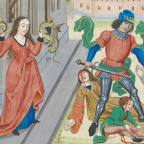
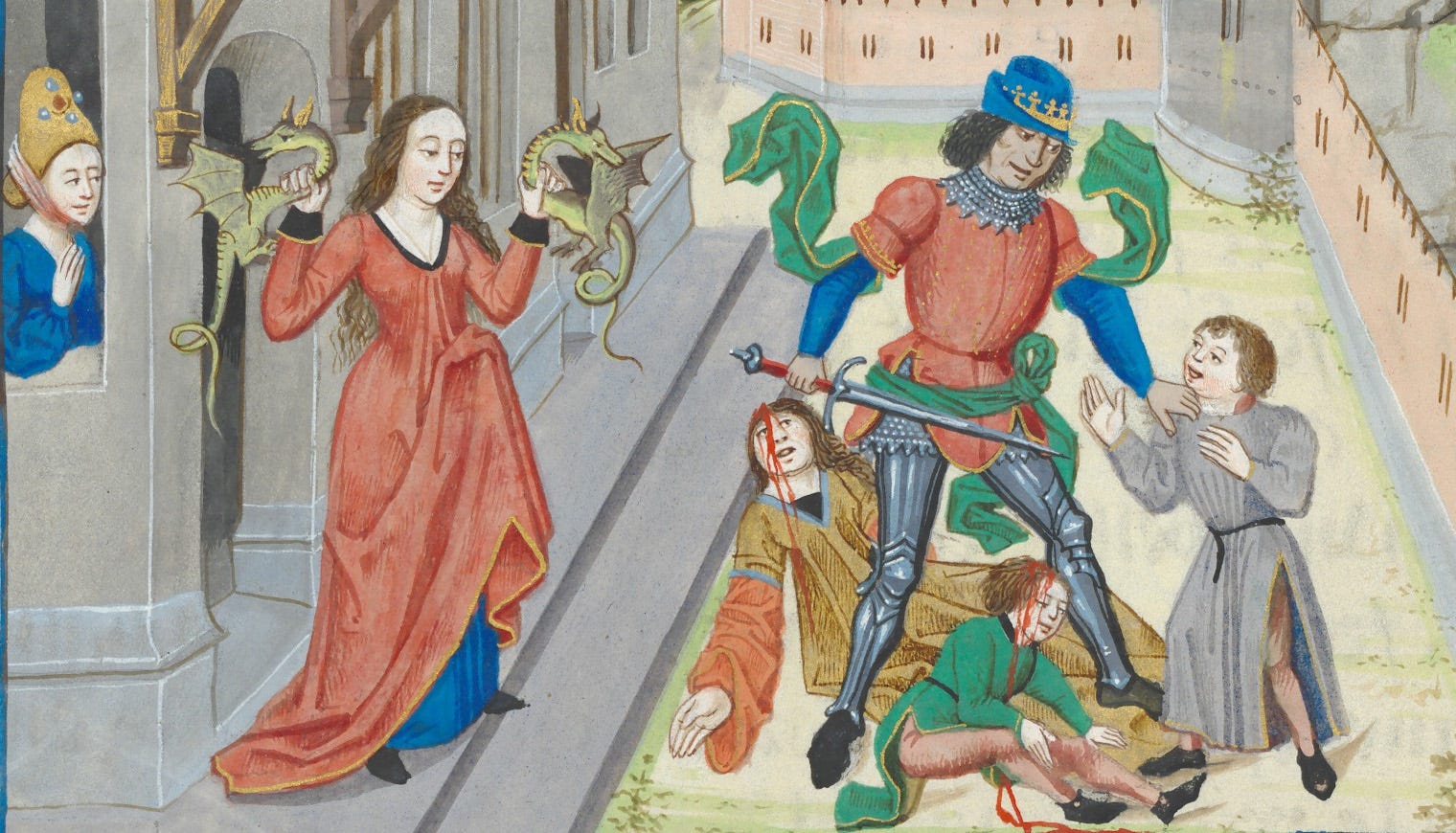
This had precedents in the Greek story of Athamas. The original myth blamed Hera for striking the king with madness, causing him to kill one son. (Greek myth frequently villainizes Hera, while praising the rapes of Zeus). But in this painting, Athamas is shown slaughtering his wife as well as two of their sons. Christine de Pizan intended this myth to be a homily on the destructive effects of rage. The text reads: “Athamas full of great rage / The goddess of [?torsennage? can’t make out the Bâtarde script] / made him strangle his two sons / for [from?] this great ire [?defend? yourself.” The artist foregrounds the Fury Tisiphone who brandishes two baby dragons, while Hera looks on. Tisiphone with her very medieval dragons is shown as a witch casting spells. The killer is not at fault: “She made him do it!”
There is some irony in this. Christine de Pizan, the first known professional woman writer in Europe, demanded to know: “Why are men so unanimous in attributing wickedness to women?” At the end of the 1300s she became the leading defender of women’s honor and rights and achievements. She was the daughter of an Italian astrologer at the French court, and because of that she had access to the Royal Library and to private tutors. When she turned 17, her father and her husband both lost their positions, and so all of a sudden she became poor. She began to write for a living, and as a widow she supported three children with her pen.
She wrote various books, aimed at an aristocratic audience, leaning heavily on classical themes. Her most successful wa L’Epître d’Othea, which followed this pattern. She responded to the misogyny of Jean de Meun in Le Roman de la Rose, then a bestseller in the courts. In 1402, she wrote a book called Le Dit de la Rose: “The Rose Speaks.” Another book of hers was called The City of Women.
And here she challenged the idea—rampant in medieval misogyny—that women are inconstant, fickle, deceitful, greedy, and more prone to sin than males. Dryly she adds, Men are not perfect. De Pizan refuted the notion that women’s morals would be ruined if they were educated. She challenged men’s belief that their wives’ advice was foolish and the familiar claim that women want to be raped. These masculine beliefs were doctrinal in her world (and in ours). She wrote,
“I could hardly find a book on morals, where even before I had read it in its entirety, I did not find several chapters or certain sections attacking women, no matter who the author was.”
Going over to her contemporary Chaucer in England, the wife of Bath agrees. She says, “It is impossible that any clerk would speak good of wives.” Clerk meaning not like we use it today, clerical work, or store or office clerk; it Middle English this word referred to priests, the clergy (same root).
But it wasn’t only theologians and courtly poets who blamed women and declared them inferior and subjected them to male rule. City magistrates permitted men to inflict terrible beatings on their wives before they reached any legal limit. And, there’s this famous claim about the “rule of thumb” origating in men’s right to beat wives and daughters with a stick no thicker than his thumb, attributed to the British judge Sir Francis Buller judge in 1782.) This saying does not originate in English common law, but the male privilege of battering wives was inscribed in various medieval laws, and upheld by the clergy.
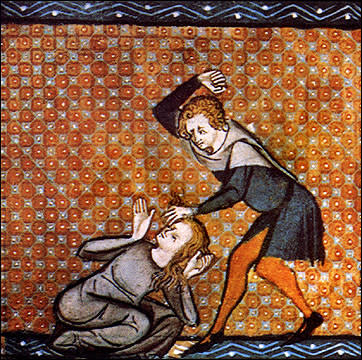
We can go all the way back to the 1200s in the French Coutumes, which merged Roman, Germanic and canon law. The authors of this code allowed a husband to beat his wife, as long as he did not kill or mutilate her. A law in Bergerac, in the south of France, encouraged the husband to draw blood, as long as he did so with goodly zeal. And there’s a whole backlog behind this of churchly assumptions and presumptions, prescriptions, that it was right that the husband should discipline his wife. That she was under obedience, and there’s a patriarchal model there, backed up by a feudal model, this whole idea of social hierarchy based on dominance
English law as well allowed husbands to beat their wives into unconsciousness, and even murder went unpunished. In practical terms, prosecution rarely happened. A law of Bordeaux allowed husbands to kill their wives in a rage, but the condition was they had to swear that they repented of it. Well, that’s easy to do, so these passes were given for serious violence. That is nowhere more clear than in a 1404 law called Les Privileges de Barréges, which gave men absolute authority over wives and children. It says any household master may beat his wife and his family, “and none shall be able to oppose him.”
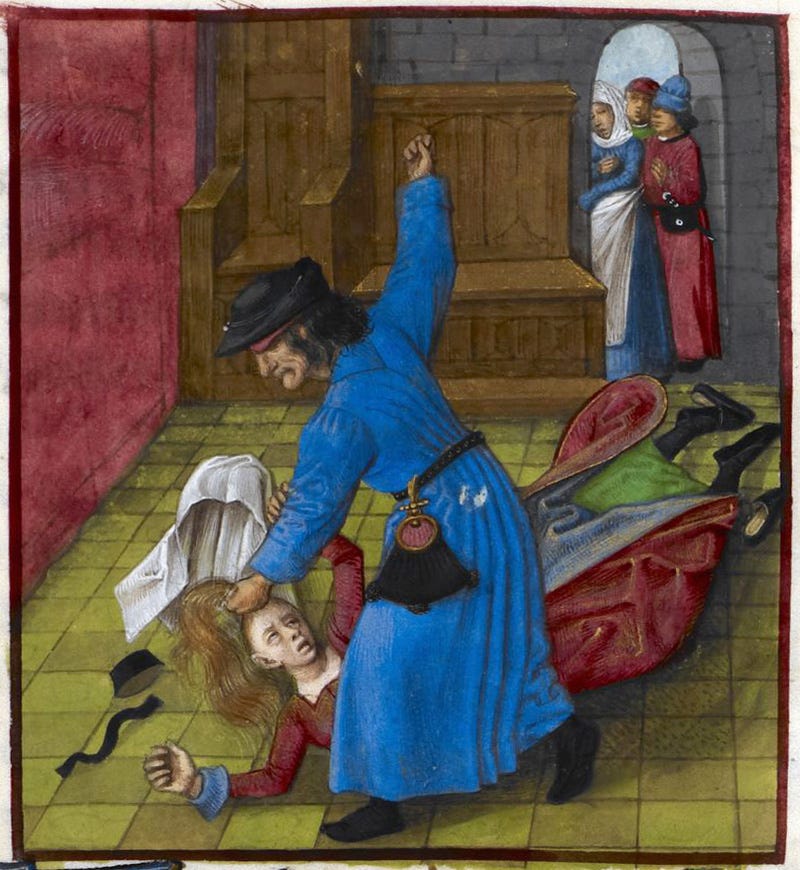
But there are layers to this. In practice, some communities did impose at least some controls on marital battering of women, through elders intervening, through protests of various kinds, sometimes ceremonialized. But this law is basically eliminating those interventions: “none shall be able to oppose him.” It’s presented as a man’s absolute right. So you have the male privilege of the husband at the most fundamental social level, and all the way up the hierarchy: lords over peasants, kings over the whole population. Priests and doctors over “witches.”
This divine right to dominate is written into law and gradually is absorbed into custom. And if you look at European history, it had been customary, male dominance had been customary for quite a long time. We can look back to written records in Greece and Rome to find plenty of evidence for that. But in other ethnic cultures in Europe as well.
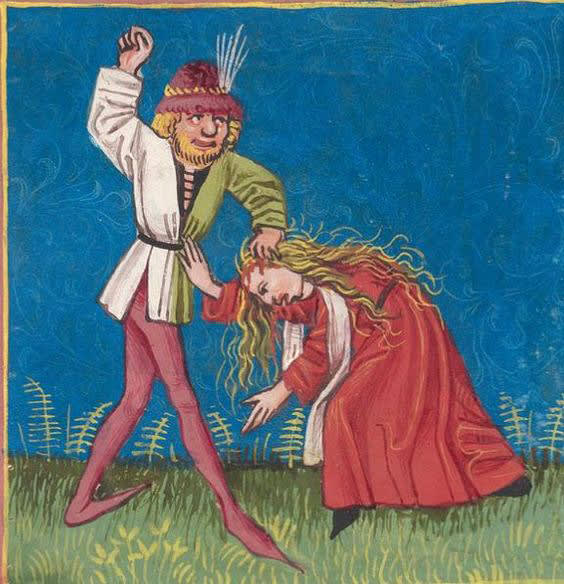
Here we’re dealing mostly with the written record, to be able to go back that far. So in Beauvais, in northern France, the lawmakers—all men of course—declared battery insufficient cause for women to leave their husbands. And here’s a quote from one of my sources: They ruled that “a wife ought to suffer much before deciding to leave the house of her husband.” Technically, these laws allowed a woman to leave if her husband was constantly beating her or if he threatened her life or if he tried to sell off her property. She was supposed to have recourse to justice in order to request that he would pay subsistence to her out of their common property.
But in practice, this income was tied to the batterer’s cooperation. And they put little escape clauses in, so the husband could lawfully avoid paying anything to the wife he had abused, simply by offering to take her back with a promise, “to give her no further grounds for leaving.” If she refused, even in fear for her life, she forfeited her share of the common property. But if she acquiesced, she could lose her life or she could be mutilated or permanently disabled she was his chattel. And this is something we can see generally in medieval European laws men as absolute masters.
So there were controls to some degree on this in medieval peasant communities, even though they were not gender egalitarian by any stretch, but they did mistrust the lords. So sometimes there are some curbs on violence. The examples I’m going to give here, some of these are from a later period, but I think that we can definitely see a continuity going on here.
Rural communities, British villages for example, would sometimes force wife beaters to “ride the steng,” or stang. That meant being paraded through the village on a stick or sometimes facing backwards on a donkey while a crowd of people ridiculed the offender. France had an equivalent to that, the charivari, or sometimes it’s called the Conduct of Misrule. These are sometimes festival occasions where people (men, actually) have a public drama. And so they would publicly shame wife beaters on some occasions, but they also enforced male supremacy. So they would single out cuckolds and men who they thought, who the men in particular thought, were dominated by their wives. So these performances had the effect of goading men to violence to prove that they were lord and master.
Another example of this in Wales, the Coultrin Court [I need to look up the spelling of this in the MS] is a good way to see how often these customs devolve into reaffirming the husband’s privilege of battery. It’s a mock court, this coultrin court, which would convene when the wife had drawn her husband’s blood, but never when he had shed hers, which was of course the great majority of cases. This is all run by men who act as prosecutor and defense. It’s public theater, in which men portrayed both a wife and husband for laughs. So you have a man dressed as a woman acting out the shrew for men to ridicule. (This too is part of the history of drag, with no female equivalent.) And they would go through town in procession with pots, pans, and trumpets. So a burlesque satirization, but it had real outcomes. A woman who refused to abide by the judgment of this male enactment of authority in the village faced the ducking stool. So men agreed that it was proper for husbands to be masters just as long as he did not go too far.
Another semi-curb on violence is that a woman’s brothers or male relatives could retaliate against a batterer by beating him up on their own. But the problem here is that this depended on a consensus among men. And what happened, and this would have begun already in the Middle Ages, probably much sooner, is that brothers would uphold the husband’s privilege of keeping his wife—their sister—in line.
So I come back now to sorcery. Women’s weapons were speech and sorcery, witchcraft. Female elders would publicly mock men who were guilty of battery or rape. They would incite male relations or the village itself to intervene on the behalf of a woman. And that’s not to say women elders always did side with the woman. I don’t think we’re looking at a period where we have much female solidarity. But there were times when women could cause some action to be taken.
But the threat of witchcraft was really the most effective deterrent to male violence. And especially, above all, a certain kind of female sorcery, the threat of magically causing male impotence. This is something that we see canon lawyers already obsessing about in 1200s. It makes its way into canon law and church lawyers are still obsessing about it in the 1700-1800s.
So European society was becoming ever more male dominated, but yet and still there’s this growing male anxiety about witchcraft. It seems that popular wisdom held that all male authority and privilege could be canceled out by the power of a witch. She could stop a man from beating his wife or sleeping around. She could negate his sexual potency, or draw him to a woman who wanted to marry him, or make him return to a wife he had deserted.
There’s an Italian poem from Tuscany in the 1400s, which lists the spells that women used to bend men to their will. It talks about collecting herbs by moonlight while saying words over them, chanting verses while drawing water at sunrise. This kind of witchcraft was also found in the fairy faith. One Scottish story says the fairies helped a wife whose drunkard husband caused so much misery to her. In the story the fairies give the wife a small stick saying, “As long as he keep this, you good man will drink ne mer.” This is an old story, women in patriarchy trying to get the husbands not to batter them while they’re soused with alcohol.
In Spain,, there were fountains with erotic powers, waters that could be drunk from that would perhaps attract a lover. Common women have this reputation for defying the sexual double standard, which is, of course, another form of male authority. You see aristocratic men taunting peasant men as cuckolds incapable of mastering their wives. This is a term, by the way, that’s been resurrected by the modern US right wing: “cucks.” This whole discourse about cucks is obsessed with men being controlled or dominated by women. But these are old, old tropes.
The stereotype of the fishwife, a woman with a loud voice, a woman who will not, who is indomitable. The “common scold” who is sharp-tongued in defending her rights, nags and scolds. And of course the scold’s bridle is intended as a public humiliation and a literal silencing mechanism. Put this head cage over the woman’s head and lock down her tongue with a special metal plaque, sometimes with spikes in it, to physically prevent her from speaking and resisting. But this doesn’t come along until the 1500s.
Caricatures of female rage are scattered through medieval sermons, showing us that women were not resigned to their hard life. The very heavy workload they had, the physical battering that they underwent, the risks of sexual violence, the infant mortality—all of these things that they suffered—and on top of that, the beatings from their husbands.
And it seems that large numbers of women would leave. They would get out of the abusive situation. The problem was where could they go. There was a common law pattern of serial alliances and de facto divorces. The church, of course, allowed no divorce, so one strategy was just not to get married in the first place. There were all kinds of battles over this. (A lot of people don’t realize that marriage became a sacrament quite late.) Some women got away with some degree of sexual independence, if they could avoid getting pregnant, but that was a big IF. Most could not, which is why historians talk about women bearing children out of wedlock at high rates. The church was very much obsessed with flogging women around the church and other kinds of humiliating punishments for fornication. Because common women were not demure. They were acting on their desires.
But the sexual double standard is very much in play in the targeting of women for things that would be tolerated in men. There’s this factor, though, that women fought back. They’re facing uneven physical odds, but laboring women were muscular enough to inflict damage on assailants and they’re walking around with knives worn on their belts and they knew how to use kitchen hatchets and frying pans—but those hatchets are the weapons of choice by women fighting in medieval court records.
You see a lot of church sculptures in England and elsewhere that show female resistance in a context that really savors of the witches’ ride. Women fighting or jousting with their husbands: broom versus hoe, or sometimes the distaff versus the sword, or lance, riding on barn animals. They’re all over illuminated manuscripts. (See my video, The Distaff and Female Power, especially the section on The Emasculating Distaff.)
And like many modern comments about the war of the sexes, the carvings mock and trivialize wife beatings. This was not an equal match, these quote unquote :fights,” physically or legally. (Think of the batterer Trump trivializing “a little fight with the wife.”) Certainly not in terms of the priestly authority.
So one of the ways that women fought back was with words, and another way was with actual physical resistance. There were a lot of different strategies. But women especially fought back by passing on to their daughters remedies that had been transmitted orally over generations. Some of these had to do with ceremonies they would perform at marriage in order to ensure that their husband would not dominate them. Welsh folklore is full of this stuff, being the first to drink from a certain well after being married. The man runs off to the well, while back at the church, the bride takes out a vial of the water and calmly drinks it. Various rituals in Germany and Russia and other places that were really about the struggle to overcome male dominance. Anyway, to assert their rights and for recourse against wrongs done to them, many women turn to the witch, or to women’s rites.
In this period, in the late 1300s, there’s a rash of sexual politics trials in Italy and France and Switzerland, women were being accused in court of using sorcery to control their relations with men, to control the men. This charge entered into baronial and episcopal persecutions. But in this time period, the late 1300s, the clergy’s fulminations against witchcraft had escalated.
And you see a growing number of cases presided over by the same magistrates that had written these patriarchal family laws that I was telling you about. But even these oppressive laws did not go far enough for them, because 14th century women refused to submit as intended. They resisted. So these attempts to outlaw female power and rights and professions and sexuality somehow failed.
Witches were foremost among those empowering women to resist. The witch acts as a counselor to poor women and she’s encouraging them to believe they could do something to get what they wanted in the world, that they had the power, somehow, against heavy odds, to keep others from victimizing them. Not to give up.
Among the earliest recorded Italian witch trials was a proceeding against Gabrina degl’ Albetti. She was a witch by public fame and had been accused by people that the court deemed “worthy of faith.” So in July 1375, she was brought before a secular tribunal presided over by the mayor of Reggio Emilia. And the court states that her career as a witch went back to 1367. The inquisitio states that she taught many persons and instructed them to bewitch with herbs, incantations, prohibited and “dishonest” acts and gestures.
Well, everything we have is recorded from the anti side here. It’s very much a male dominant perspective, but what we can extract from these court records was that Gabrina was helping women in their problems with men. So women who had been battered or betrayed or abandoned by their husbands came to her. Husbands moving in with their girlfriends was one of the most common problems. They couldn’t divorce, so they would just say, Screw you, goodbye, I’m going to go move in with a younger woman.
The case of Franceschina Avanzi prompted the first charge raised against Gabrina. Franceschina was in desperation because of the constant violence that her husband subjected her to. The spell as described in this court record (and this is certainly not the full story) but it says that Gabrina instructed Franceschina to put her own leg hairs and her husband’s fingernails into the heart of a black hen, place it in her vulva, and take nine steps carrying a lighted blessed candle (that magical nine there) and then reduce the heart to powder and mix it into a dish to be served to the unfaithful husband. This is a theme of women’s sorcery that is really widespread, mixing things into the food, because they’re the food preparers, right? And you’ll see women of African descent doing this, and in the Arab world too.
The second charge against Gabrina was that she had helped Jacobina, the wife of Pietro di Parma and she wanted to make him stop beating and verbally abusing her and to leave his girlfriend. So again, unfaithful husband beating his wife, two wrongs packed up into one. So the witch advised her to feed him chamomile powder to calm him and make him easier to handle. Well, you can see this is a real hard uphill road; I don’t know that chamomile is that powerful. But anyway, there’s also the dimension of the rituals that she’s employing and the charms and so forth that are an important part to this.
But it’s also the idea of giving her something to use as a remedy. And so this chamomile prescription, she also gave to Katina Mazzoli, Agnesina Distregis, and the wife of Prosperino. These are from the court records. But the black hen heart remedy failed for Elisabetta Potaccini, so Gabriela told her to throw salt into a fire while chanting, “So might Botasso be hot for me as his mother was for him.” And she was to put her hand on her vulva, then on her mouth, and her husband would kiss her there passionately.
Another woman who was deserted by her husband was recommended a different ritual: to adore a star and salute it and then twist her shirt, saying that as the shirt was twisted so would the heart of her husband be instead of her own. And these star adoring ceremonies I found also referred to in Spanish records. So this is a wider form of women’s magic.
The strega Gabrina also dealt with women who wanted the love of certain men or whose love was not being returned. The court papers indicated some of these women did end up marrying their man. She also treated a man who was terrified of women and he would become overcome with fear whenever he tried to approach them. So she told him he would be freed if he got a sword that had killed a man, placed it in a bed, and slept there with a woman.
None of this testimony shows Gabriela de Albeti harming anybody. But the court ruled that she was a sorceress and enchantress who had violated the laws of church and state. We don’t know that she was ever burned at the stake; the only court record that we have says that they condemned her to be branded wit the mark of infamy and to have her tongue cut out. There’s no more record of her fate. We do know, though, that a lot of times these persecutions were serial and cumulative, so that a woman who was convicted earlier on would later on be burned or that the accusations would keep on coming. There are many, many examples of that in the course of these witch hunt records.
There’s another example from Italy in Scarperia in the Mugello. The only woman in this period to be executed for practicing sorcery was Giovanna di Francesco. Again, for witchcraft to make a man love a woman. She also performed a spell to make the man who fathered her three quote-unquote “illegitimate” children return to her from Hungary. And these are all cases of her doing witchcraft on her own, not as a practitioner or a counseling witch. They also say that she did divinations on the eve of her marriage to a weaver from Venice, using Christian prayers. This period, it’s not all pagan. A lot of substitution of saints, otherwise you’re in more danger—so using christianized formulas, that can be seen as prayers and not as spells. Anyway, Giovanna di Francesco was beheaded, not burned at the stake. There’s a lot of variation in this period about what kinds of punishments are used.
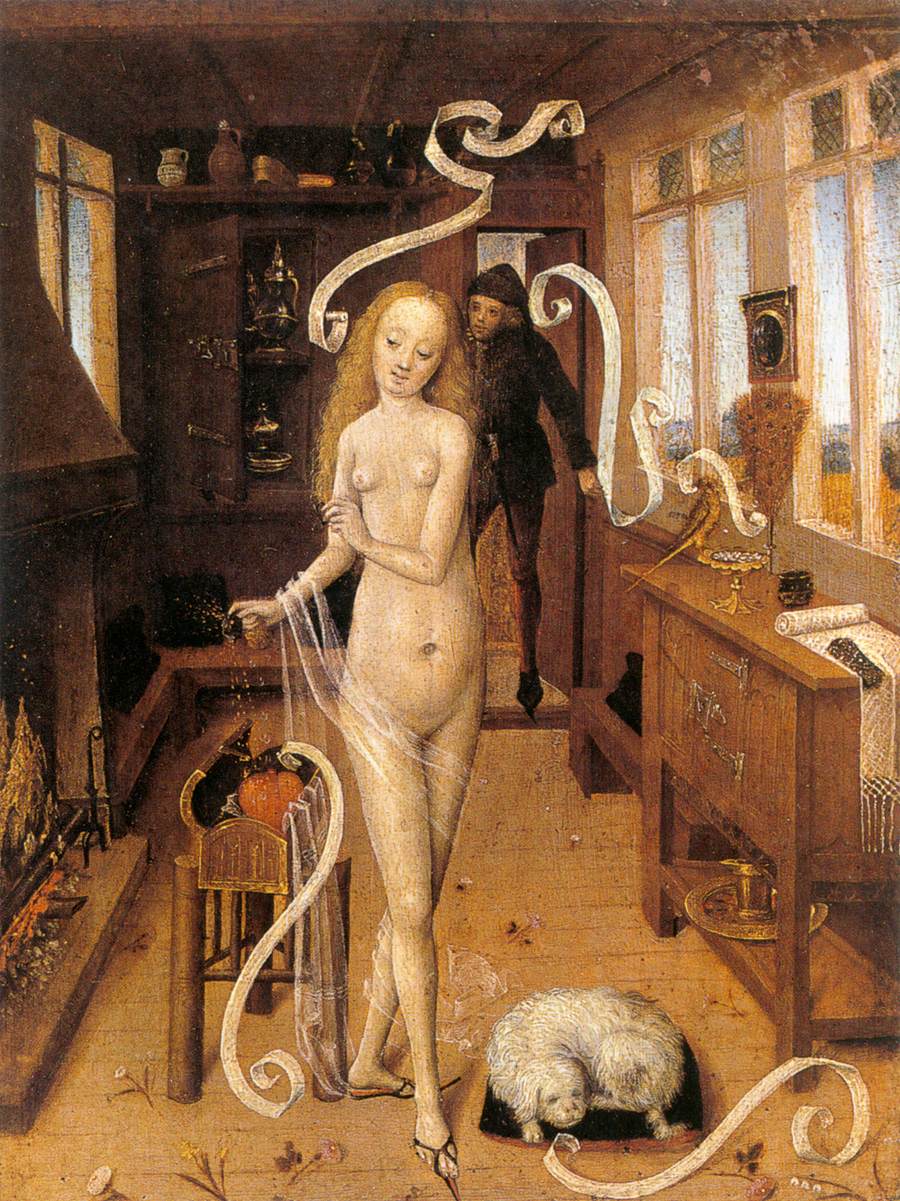
In 1370 there’s a woman in Florence named Marta who was arrested and tortured as a witch. She was said to have been seen making magical signs as she stood naked over a dish with burning candles. What’s interesting about this is that a contemporary Flemish painting shows a naked woman making passes in a similar rite to attract a lover, and a man is poking his head through the door. The artist is showing that her ritual succeeds, because here he is; it brought him.
In 1407, there is somewhat rare, several Swiss noblewomen, aristocrats, being tried in Basel for using witchcraft to win back the attentions of their husbands. And these women ended up being banished. Women of the upper class were mostly immune to witch prosecutions, but some better known cases involve aristocratic women, with more likelihood of their cases being written down.
In 1370 the English Parliament tried Alice Perrers for witchcraft. The claim was that she had used love spells to gain control over the king, Edward III, whose mistress she was. His indifference to politics was equal only to her involvement in royal affairs. So the accusation of love sorcery was a pretext for aristocratic men to undermine the political power she exercised in her proximity to the king. In the witch trial of Petronilla de Meath, she became the fall gal for her mistress, Lady Alice Kyteler, in another political trial. Same with the Witch of Eye, burned in 1440, for allegedly helping the duchess of Gloucester get married to a powerful man. The lady escaped the stake but was made to undergo public humiliation in penance. Cases like this, punishing a common witch for (supposedly) helping a powerful person, go back to the Frankish period.
Meanhile, the services of witches were in demand among common women. And some of the names for witches indicate that they were often old women. So French vieille femme, as a synonym for “witch.” Welsh gwrach really means a hag, a magical hag. In Polish kobieta stara, old woman as a witch. Even sage-femme in French, “wisewoman,” is often used for midwives. There is this overlap between women who were healers or midwives and witchcraft, famously in the Malleus, but also in an earlier text, Le Vauderie de Lyonnais en bref, around 1440.
Going back to Italy, Matteuccia Franceschi in Castello di Ripa Bianca was doctoring babies suffering from worms, but she had another specialty. And this is a quote: “Countless times she brought husbands back to their wives and faithless lovers back to their girlfriends.” So we can see that women were her constituents. And this old woman was burned at the stake in 1428 as “a woman of evil condition, life, and reputation, public enchantress, sorceress, and witch.”
I have some other stories here from French witch trials and I’ll save those for another episode on the sexual politics of the persecution. I don’t want this to get too long, but will just put this one piece in, from the torture trial of a woman named Macette. who was married to Jean de Ruy. She’s tortured until she says, “I got this man to marry me by using a special ointment,” and they moved to another village where they ran a tavern. The court transcript says:
“During that time between her and her said husband, there were numerous quarrels and arguments, as much because her said husband abused and beat her because she didn’t want to do and carry out his wishes, as because she answered him very harshly and sharply, telling him that she was as good as her said husband was.” (This stiff language is typical in these court records.) “For which thing he led her a very bad and hard life beating her as often as not; and so she seeing that in no way could she stay with her said husband because of the beatings he gave her, remembering and considering part of the things told to her by her aforesaid and this is female neighbors of Ruyi and Anjou that she had found to be true and wanting to try and know if the other things here written above told by them to her, might also equally be true, on a certain day she does not recall, she being alone in her room in the inn in the said place of Gerard, her aforesaid husband absent and about his business she called three times one after the other, prayed and requested that the aforesaid Luciafer to help her to put her husband in such a state that never in this world could he beat or abuse her who spoke.”
So this confession sounds a lot like other witch testimony extracted under torture or the threat of torture: the calling on the devil, a wax image molded and poked with a knife. But there’s a more realistic ring when Macette is talking about her miserable marriage to a tavern keeper and all this battering with alcoholic overtones. And her reference to the fact that women neighbors advised and taught her sorcery for marriage situations is especially intriguing. I just wanted to throw that in there because you can see how this is something that shows up in the court transcripts.
The trials function to enforce male dominance, to impose interpretations on the story, to re-spin it according to the prejudices of the clergy and the magistrates, whoever is in charge of these trials. I’ll come back in another webcast and I’ll talk to you about two other important cases in Paris, completely imbued with sexual politics, but I’m going to move forward here and talk about what happened at the end of the 1300s, when the sorcery charge was like oil poured on the fire. The learned doctors of the Sorbonne were fanning of the flames of sorcery mania. The university professors were dabbling a lot in demonology, piling it on the already existing doctrines of male supremacy in canon law, in both church and state law.
The scholastic demonologists, these professors of the Sorbonne, were being called on as expert witnesses consultants on theology and law. And they were all too happy, eager in fact, to seize this opportunity to inject their their woman-hating commentary into witch trials going on in Paris, because there they were, right there at the Sorbonne.
So their sensationalist charges against the sorcière, the witch, were repeated in the streets along with news of the latest executions of poor women. And the fact that a lot of people in the community were coming to watch these women being incinerated was part of the overall climate that women were finding themselves in. They weren’t getting any sympathy for whatever their husbands were doing to them.
And in the wake of the burnings of several of these sorcières in sexual politics trials in the 1390s, the theological faculty at the Sorbonne delivered a really crucial blow in their war against the sages-femmes, against the wise women. Several years after these burnings of insubordinate females, in September of 1398, the learned doctors proclaimed 28 articles defining sorcery as a pact with the devil, “the enemy of God,” and therefore as treason, blasphemy, and heresy, and thus worthy of death.
After years of field testing in the Inquisition, they could apply these methods to ordinary women fighting patriarchy in the home. First, the Inquisition had been launched to fight the Cathars, and then expanded to go after other heretics, the Waldenses, and then gradually more and more they began to burrow and extend their sphere of authority to witchcraft. So the French word for Waldenses, Bible Christians, got turned into a word for “witch.”
The problem for the clergy was that there were doctrinal barriers (I won’t get into details about that right now, but briefly) they came up with a new rationale for witch persecutions. They called witches heretical, because they were quote-unquote “devil worshipers” according to the demonologist scholastics. By calling them heretical, this removed an old canonical obstacles to inquisitors taking action against witchcraft. Now, those obstacles had never been unsurmountable to the more zealous inquisitors. But we are seeing from about 1370 on, sorcery charges begin to figure prominently in inquisitorial torture trials, from northern Spain and into southern France and northern Italy.
In order for mass prosecutions to proceed, an old doctrine called the Canon Episcopi —which described witchcraft as a heretical illusion —had to be pushed out of the way. The new definition said, Now there’s really a dangerous new sect; this is not like what the church fathers (who are always right) were talking about before. This is a new pressing danger threatening all of society.
So this 1398 proclamation of the Sorbonne theologians declared that witchcraft was a growing threat that had never been so widespread. And it actually spells out that a pagan revival was in progress. As Henry Charles Lee, the historian of the Inquisition and the witch hunts, summarized over a century ago: “The preamble recites that action was necessary in view of the active emergence of ancient errors which threatened to infect society. The old evils [we’ll put a question mark over that] which had been well-nigh forgotten, were reviving with renewed vigor. The university then proceeded to declare that there was an implied contract with Satan in every superstitious observance.”
So the folk magic and medicine now becomes devil worship. (Actually the early medieval bishop had already started calling it that). The scholastic theologians now condemned as heretical error any assertion that it was permissible to invoke the aid of spirits (“demons”) or to seek their friendship or to use sorcery for good purposes or for the cure of sorcery.
And so at the end of the 1300s, the momentum of witch persecutions was pumped up by an alarmist coalition of theologians, secular prosecutors, and disgruntled husbands. Both the church and state, whether that was the old aristocratic order or the magistrates of the rising bourgeoisie, found convenient scapegoats in women witches for the crisis of a collapsing social order.
We have to look back now at the larger context. Social dislocations, severe economic hardship had disrupted transmission of the old folk heritage. People in the 1300s had already been through the shocks of famine, war, the bubonic plague, the smashing of peasant revolts, brigandage, and the first century of the Inquisition. Under those hammers, the culture of the besieged commoners lost a lot of its original shape and its transmission. People were starting to move away from the land and growing numbers and into the towns.
And there were no groves and natural grottos there. There were churches. More people were going to mass and hearing sermons denouncing sorcery and the evils of female “vanity.” So, this was being propagated by the clergy. Those who did not attend church ran the risk of excommunication, with a further risk of being hauled in front of the Inquisition. Coming under suspicion because they weren’t submitting to the authority of the priesthood.
So you see human realities being violently brought into line with misogynist codes, whatever the human cost, and that cost was high in such desperate times. It would not be paid by rulers and prelates, by the priesthood, but by the common people—most of all the women. The poor would lose their healers, oppressed peasants and town dwellers would start to turn against their own kind, trading scandalous delusions for a reality of class oppression they feared to confront. Who dared to confront the lords that sat at the top of the heap? In the coming conflagration, he old and disabled would be attacked above all women— unmarried crones, vagabonds, wives, prostitutes, wisewomen, beggars, midwives—women would be burned. (Or hounded, banished, fined, or imprisoned.)
People began to be influenced by the dogma of the torture trials that had begun to proliferate. The definition of “witch” changed for the worse, to diabolist terms. We can see in the trials of the late Middle Ages witches were still very often understood to be healers, diviners, blessers, enchanters, as well as counselors. Sorcery was pagan and therefore a forbidden art. So it was not considered crucial to show evidence of evil intent. The churchmen who were denouncing witches sometimes still acknowledged that these women were achieving results. They healed, their predictions came true, they caused or prevented conception.
But by Renaissance times, when the witch craze begins to take hold in an epidemic way, most of the doctrinal and legal authorities refused to concede that their targets did any good and they cast them exclusively as slaves of the devil. This devil was now also increasingly male, whereas before, the bishops used to call Diana the devil, or some ethnic goddess that these witches are associated with.
As the demonologists’ views took hold in the larger society, the witch hunting frenzy ran like fire through the social fabric of Europe. The positive spiritual values of the pre-Christian cultures were consumed in the blaze. Women’s roles, professions, and behavior were permanently transformed.
I’m going to stop there, but I’ll just add, on the names of the witch and the demonization of the witch, I talk about that in chapter three of my book Witches and Pagans: Women in European Folk Religion. (Free download here.) The names are not what we are led to expect of the witch, as a harm-doer, who commits malicious sorcery. The ethnic titles for witch refer to women who are seers and knowers and healers and herbalists—various types of spiritual knowledge, shapeshifting and working energy.
The common people are still seeing them as helpers and healers, as wisewomen. That’s important to know, because from our historical vantage point we are facing such a heavy overlay of demonized images of the witch, now including Disney cartoons and all of the mass market Halloween culture. We need to understand that in the folk culture, there were alternative ways of seeing all this besides what the elite men of church and state, the universities, the bishops, the canon lawyers, claimed. The local village priest who was sometimes in on these folk practices himself) as well.
In the early middle ages, in process of trying to stamp all of these things out, the clergy actually perserved some record of them. They were writing down, “They do this and they do that,” in order to stamp out pagan customs. As a result of their repression, we have a written record. It’s not complete, but it’s a partial record that can give us some idea about who these women were,what the cultural names for them were in each ethnicity, and some of their spiritual/ practices.
In the next episode, I’ll talk more about Jean de Brigue, known as La Cordière, in the 1390s, one of the witches that was brought to trial in Paris. I’ll give a more detailed breakdown of the sexual politics of accusing husbands, and witches that women were consulting because they were being deserted by their lovers or husbands.
And if you’d like to support this independent scholarship, then you can become a paid subscriber to this substack, or contribute to my Matreon.


