The Libyan Connection
African Influences on "Dark Age" Greece

In the early years of writing Women in Greek Mythography, I came across ceramic paintings of dancers and mourners, dating to 800-700 bce, in what is known as the Late Geometric period of Hellenic art. I was struck by their resemblance to Libyan rock paintings, especially those of the Garamantes culture, circa 1000 bce. They outline people’s face in profile, but the shoulders face forward, and then the hips and legs are shown in profile again. This is a widespread African style that is visible in Egyptian reliefs and paintings, but shows up in far older Saharan rock murals.
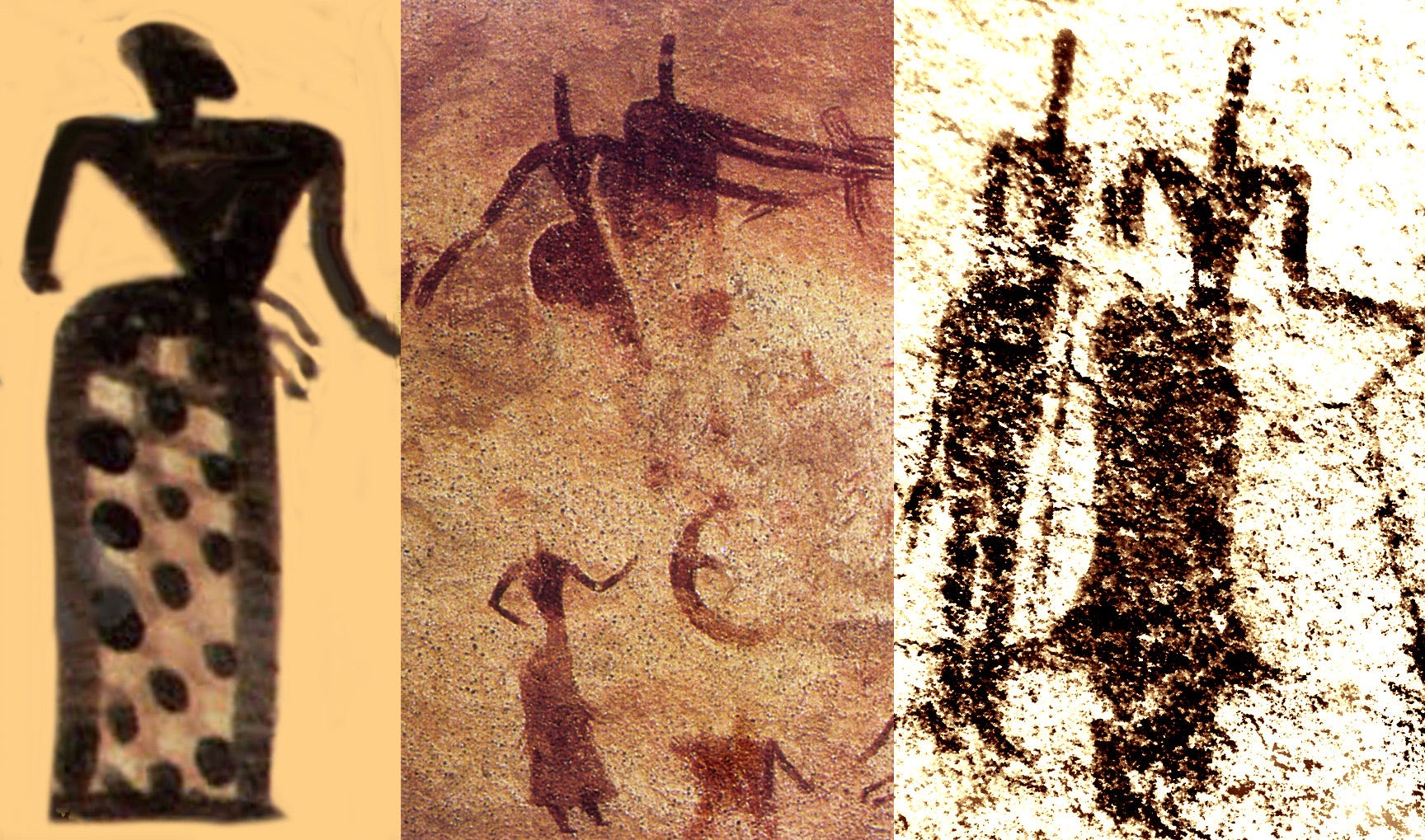
The Greek dancers and mourning women follow a North African pattern, specifically the Libyan style of amply-butted women in long skirts. (The skirts often are tailed, probably based on that shape of cut cattle hides, leaving corners of leg skin. See image at upper right, just below.)
The Late Geometric paintings of Greece often show African facial profiles and coiffures. Sometimes the women’s hair is close-cropped (both images on left), or in long locs that rise up and away from the head (upper right), or in short twists (lower right). The rendering of the prominent lower jaw strongly resembles that of African rock paintings, not only in the Sahara but in the Kalahari and Zimbabwe. It bears no resemblance to Archaic or Classical Greek styles.
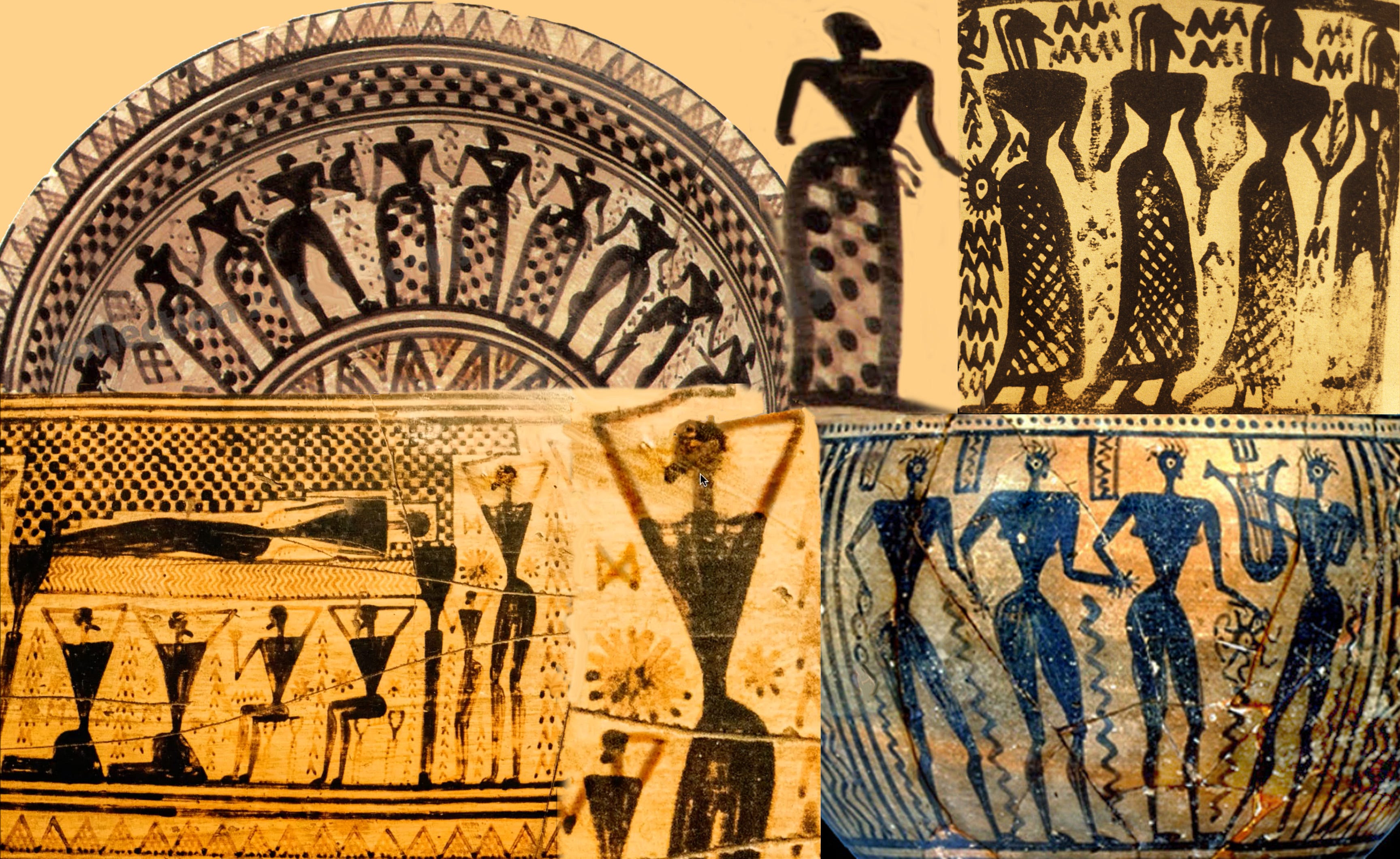
That’s not to say there were no continuities in the Hellenic tradition. The ceramic paintings reflect the ceremonial hand-in-hand dance that was pervasive in the most ancient Greek culture, all the way back to the Mycenaeans and Crete, and forward in time until Christian patriarchs strove to quash dance, percussion, and music. The hand-in-hand lines of dancers recall Ariadne of Knosso and the winding geranos (crane) dances she was said to have taught Theseus, which he passed on at Delos. Also, the motif of female mourners raising their hands above their heads goes back to Mycenaean times, painted on multiple larnakes (ossuaries). (Egyptian paintings also depict women mourners, but the gestures are different, hands raised before the face.)
So we can look at those patterns of representation, and ask, How did that African influence reach Greece? Attica in particular, where these ceramic paintings are concentrated. No one knows. I can speculate that after the Mycenaean collapse of the late bronze age, which took out the previous polities and economies of every country but Egypt, trade and travel resumed very slowly, maybe in patterns not known before. But I don’t have an explanation. I’m just seeing artistic patterns that are unlike any others in the hemisphere.
But then I came acroos another line of evidence in the oral tradition, which was eventually precipitated into the written record by poets, playwrights, and historians in stories about the Danaides. These old mythic legends have antecedents, pre-stories, that look to Africa (albeit through a European lens, but one in awe of Egyptian antiquity and knowledge). They begin with an ancestral cow-woman Iō (who may vaguely draw on Isis). Here’s an excerpt from my book showing how the Iō lineage lays the ground for the Danaides myth:
Iō becomes the apical ancestor for the genealogies of Perseus, Herakles, and the House of Atreus, all central actors in Greek legend. Her story begins in Argos, one of the oldest continuously inhabited cities in the world, and a major center of Mycenaean power. Zeus comes after Iō, who refuses his advances. In his desire to please Zeus, and fearful of the god’s threat to extinguish his lineage, her father throws her out of the house and bars the doors. This forces Iō out into the fields, where Zeus rapes her. Hera is enraged, but not against her unfaithful husband. According to a depressingly common script that has her constantly retaliating against the women that Zeus rapes, Hera turns Iō into a white heifer, and sets a gadfly to drive her wandering over the Earth. [This patriarchal take overpasses the fact that Hera herself is a cow-woman, often referred to by the eponym Boōpis, “cow-eyed,” and with ceremonies around cattle at her temple in Argos.]
Iō leaves Argos, crosses the Bosphorus, travels around the Black Sea and through the Caucasus, then down through Anatolia and the Levant. She arrives in Egypt, where Zeus finally gets around to restoring her to human form. The Book of Jeremiah seems to allude to this story: “Egypt is a beautiful heifer, but a gadfly is coming against her from the north.”
In Egypt, Iō gives birth to Epaphos (equated with the bull-god Apis). He marries Memphis, daughter of the Nile, and becomes king of Egypt. (None of this relates to actual Egyptian history; it is purely a Greek construct.) Memphis in turn gives birth to Libya, who becomes a great ancestor of nations. By Poseidon Libya bears Belus, the father of Aegyptos and Danaos, whose daughters are the Danaides.
Libya also generates an Asian line through her son Agenor, king of Phoenicia, and his wife Telephassa. Their children are Europa, Phoenix (thus Phoenicia), Kilix (Kilikia in southern Asia Minor), and Kadmos, who founds Thebai in Boiotia, Greece. A third branch of Libya’s descendants are in Crete, where Europa of Tyre bears three sons: Minos, Sarpedon, and Rhadamanthos. The children of Minos and the titanis Pasiphae are Ariadne, priestess of the labyrinth, and her sister Phaedra—both tragic women in myth. [As was Iō!]
Hidden in this tangle of relationships is an understory of linkages to Africa. Libya is the ancestor of the Greek Danaides (“women of Danaos, of the Danaoi”) and also of the Phoenicians and Cretans. (The Phoenician connection to “Libya” is not far-fetched, given their Tunisia colonies. Also, Semitic languages belong to the Afro-Asiatic family, with its broad center of gravity in Africa: Egyptian, Amazigh / Berber, Tigrinya, Amharic, Chadic, and Omotic).
The Greek narrative recognizes African influences on Levantine and Aegean cultures, although it does interpose Argive Iō as the ultimate ancestral fount. Stories about the Danaides suggest an orally-transmitted memory of North African immigration to Greece.
In the 15-page book excerpt below, I lay out the legend of the Danaides, their ancestry, the theme of women resisting forced marriage within a dynastic context, and their attempt to seek refuge in a foreign land. Another strand of the myth has to do with Indo-European origins of the Dan- names for rivers and goddesses across a vast span of Eurasia, from Ireland to India, and their connection to mythic peoples (the Danavas, Tuatha Dé Danann). The Iliad attests to the Danaoi as a name for Hellenes (who are also called Akhaoi and Argeoi). Even older are Egyptian ethnonyms for Greeks, as Denyen or Tanayu, all the way back to 1437 bce. So several lines of meaning exist, but they overlap. So the river-names in Europe resonate with the water-connections of the Danaides (and in another myth, Danaë) and of the Danavas in India.

Then the chapter turns to the Libyan Connection in archaeological evidence of the painted ceramics of the Late Geometric, with more illustrations of ceramic paintings and of African rock art, and commentary on them. The excerpt below is for paid subscribers only (yes, finally some honey for you, thank you!) but you can also get the book and see much more. I also show some of this material in my video about the book.
See many more Saharan rock paintings in a wide array of styles in my video: