Destroying the Temples
Part II of the War on Pagans, in Magna Mater, Paulianity and the Imperial church

Toward the end of the 300s, church and state were in a position to stage a full-scale attack on the temples. Bishops took a leading role in inciting the destruction of the ancient Mediterranean heritage. John Holland Smith has documented this process in detail: “The monks and hermits formed the spearhead of the Christian revolutionary army. Often, they were invited into new areas by local bishops especially to undertake the ‘depaganisation’ of the place.” [Smith 1976: 162]
The religious militants were backed up by government officials and soldiers. The Syrian orator Libanius described how “men in black”—monks—“rush upon the temple, carrying baulks of timber, stones, and fire.” They knocked down roofs, undermined walls, stripped metals from the great doors, threw down altar,s and smashed statues. Libanius describes how these monks pillaged the wealth from local temples: “They go about in gangs, attacking each village in turn.” [Smith 1976: 66]
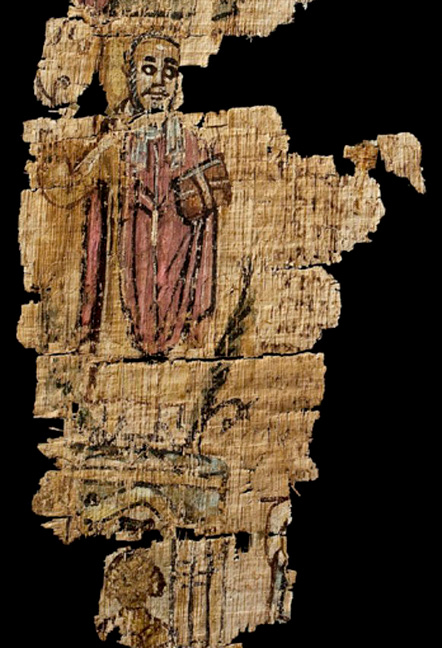
Theophilus, Patriarch of Alexandria, destroyer of the Serapeum and other temples
Archbishop Theophilus of Alexandria moved to demolish the great temple of Serapis in Egypt, but popular resistance prevented it for three years. The Syrian bishop Marcellus and his monks tried to level the temples of Apamea and Edessa. Both these attempts were met with resistance from the common people, who were eventually “silenced by the name and authority of the emperor.” [Gibbon, 263] In real terms, they were restrained by the presence of troops and the threat of proscription: declared civilly dead, enemies of the state whose property could be confiscated, and who could be exiled, even executed. [Smith 1976: 173; Chuvin, 134] Monks moved in to occupy the sites, to prevent people from carrying out any ceremonies there.
In 385, emperor Theodosius sent the praetorian prefect Cynegius to stamp out sacrifice and divination in the Eastern empire. Cynegius exceeded his orders, demolishing temples in Asia Minor, Mesopotamia, and Egypt. [Smith 1976: 163] He demolished most of the massive Syrian temple at Apamea. Its columns were so colossal—26 feet in diameter—that he was only able to overturn them by undermining the bases of three columns with wood beams and burning those. When these columns fell, they caused the structure to collapse with a deafening crash. [Theodoret, Historia Ecclasiastica, V. 21]
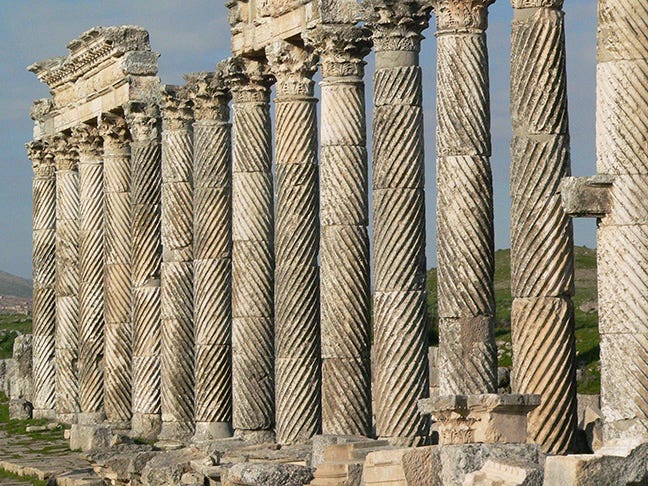
Ruins of the temple at Apamea, Syria, with its magnificent spiral columns
Cynegius also demolished all the temples at Palmyra in the Syrian desert, among which would have been the temple of Atargatis. He tore down the temple of Apollo at Didyma, where Artemis Pythia was worshipped, and where female oracles went into prophetic ecstasies. [Smith 1976: 31; for details see Dashu 2023]
The monk-turned-archbishop John Chrysostom led the charge in Syria and Phoenicia. In 386 he preached a series of 21 sermons against pagan statues and temples. Despite being a notorious misogynist, he convinced wealthy women to donate money for the demolition of the temples of Antioch, which had so far remained intact. He attacked Artemis of Ephesus, Phrygian Kybele, and also shut down the city’s synogogues. [Smith 1976: 174-75] In the 5th century, Demeas “destroyed a deceitful image of demonic Artemis” in Ephesus and set up a cross. [Budin, Artemis, 2018: 161] However, the countryside resisted. In the provinces, people rose up in protest against the destruction of their cultural treasures.
A few pagans braved the danger of speaking up for their almost-lost cause. In his Defense of the Temples (circa 386) the Syrian orator Libanius pleaded with emperor Theodosius I to spare the legacies of the ancients. He went to great lengths to placate the Christian emperor, “for I fear lest I should offend,” but he took the risk of speaking, at this make-or-break moment for the ancient heritages. He said that black-garbed monks “who eat more than elephants, and demand a large quantity of liquor,” were demolishing the temples:
these men, O Emperor, even whilst your law is in force, run to the temples, bringing with them wood, and stones, and iron, and when they have not these, hands and feet. Then follows a Mysian prey, the roofs are uncovered, walls are pulled down, images are carried off, and altars are overturned: the priests all the while must be silent upon pain of death. When they have destroyed one temple they run to another, and a third, and trophies are erected upon trophies...
They, therefore, spread themselves over the country like torrents, wasting the countries together with the temples: for wherever they demolish the temple of a country, at the same time the country itself is blinded, declines, and dies. For, O Emperor, the temples are the soul of the country; they have been the first original of the buildings in the country, and they have subsisted for many ages to this time; and in them are all the husbandman's hopes, concerning men, and women, and children, and oxen, and the seeds and the plants of the ground. Wherever any country has lost its temples, that country is lost... [Libanius, Pro Templis, online. More quotes follow.]
Libanius lets us in on the disputes raging in the wake of laws that forbade pagan sacrifice, which usually involved feasting at the end of the ceremony. These feasts continued, although they now had to be done without altars, or burnt offerings so as to avoid the harsh legal penalties. The orator cites objections from Christian officials that “oxen have been killed at feasts and entertainments and merry meetings.” Libanius replies that the people do not break any of the emperor’s laws when “meeting together in some pleasant field, kill a calf, or a sheep, or both, and roasting part and broiling the rest, have eaten it under a shade upon the ground... though they should have feasted together with all sorts of incense, they have not transgressed the law, even though in that feast they should all have sung and invoked the gods.”
“the temples are the soul of the country; they have been the first original of the buildings in the country, and they have subsisted for many ages to this time…”
The Syrian orator carefully constructed a hypothetical debate so as to avoid the impression of directly challenging the emperor. One character asks, “Why then do you run mad against the temples? When you cannot persuade, you use force. In this you evidently transgress your own laws.” And: “How can these men reject their fellow-subjects, differing from them in this matter? By what right do they make these incursions? How do they seize other men's goods with the indignation of the countries? How do they destroy some things, and carry off others? adding to the injury of their actions the insolence of glorying in them.”
Libanius appealed to the precious value of the art being destroyed, saying that such fine works of sculpture and architecture, could be used for other public purposes. He even characterized the temples as the property of the emperor, hoping this might lead him to protect them. But in spite of his eloquence, the appeal of Libanius to the emperor failed.
KEY EVENTS IN THE WAR ON PAGANS
319-20 Divination banned, punishable by burning at stake
321 First perecution of Donatist Christians
324 Outlawing pagan sacraments (repeated in 352, 356, 451)
328 Constantine strips temples of gold, silver, statues to adorn his city
333 Constantine orders courts to enforce judgments of bishops
337 Emperor Constantine finally baptized on his deathbed
340 Constans outlaws pagan religion (Cod. Theod. 16.10.2; repeated many times)
346 Ban on public sacrifice; imperial edicts close temples
349 Pagan revolt led by Magnentius
355 Constantius proposes death penalty for idolatry and sacrifices, temple closures
356 Sacrifice forbidden again; sack of the great temple of Serapis, Alexandria
357-58 Constantius orders burning of people who consult diviners, astrologers
361-63 Julian, the last pagan emperor, issues a new Edict of Tolerance (overturned)
364 Valens persecutes ritual, philosophy; forbids night sacrifices
364 Emperor Jovian orders the burning of the great Library of Antioch
367-74 Imperial terror persecutes diviners, magic, learning; Maximus the Sophist executed along with many other philosopheres
370 Book burnings across the Eastern Empire
375 Aesclepion of Epidauros, a famous healing and dreaming temple, closed down
380 Decree handing over all heterodox church buildings to the orthodox priesthood
380s The nemeton at Argentomagus (Cotswalds, Britain) destroyed and desecrated
380s North Italian bishops rage against Diana
381 Sacrifice banned at all shrines. Christians who convert to pagan to be punished
381 Constantinople: Aphrodite temple made a brothel; Sun and Artemis, to stables.
382 Divination at shrines banned. Temples surveilled for any “surreptitious oracles’
384-88 Cynegius destroys temples in Anatolia, Syria, and Egypt
386 Libanius appeals to the emperor “In Defense of the Temples”
387 Pagan Alexandria rises up to defend the beseiged Serapeum; street battles
390 The Goths sack Rome
391 Temple ceremonies prohibited, again. Symmachus exiled for defending pagans
391 Oracle of Delphi silenced. Serapeum of Alexandria beseiged and demolished
392 Prohibition of private sacrifices, home rites. Mysteries of Samothrace closed
393 Altar of Victory temporarily restored in the Senate.
383 Theodosius bans pagan Olympics, Pythian Games; temples of Olympia sacked
394 Hasty conversion of the Roman Senate
395 Emperor Honorius bans pagan sacrifices, yet again
396 Greek Mysteries halted; Goths allowed to sack Eleusis and other Greek temples
396 Arcadius decrees that paganism is high treason; priesthoods imprisoned
398 Order to destroy all temples; in the East their stones used for roads, ramparts
399 Temples destroyed in north Africa
401 Temples in Carthage destroyed, pagans killed
405-6 Demolition of the great temple of Artemis of Ephesus, Seventh Wonder
405 Temple destruction in Palestine, especially Gaza, and in Cyprus
400-46 Monks cut down sacred trees in Bithynia (NW Turkey)
407 Burning of the Sibylline Oracles (not the originals, which were long gone)
409 Honorius banned astrologers
410 Paganism outlawed completely (Cod Theod. 16. 10. 20-21)
414 Cyril of Alexandria destroyed Isis temple at Menouthis and christianized site
415 Mob of fanatics assassinate the eminent philospher Hypatia of Alexandria
416 Repetition of edict outlawing paganism (Cod Theod. 16. 10. 22)
423 All pagans in the Eastern Empire proscribed
429 Theodosius II declares pagan religion to be “demon worship,” and imprisons pagans, seizes their property
429 Sack of the Parthenon
435 Edict orders city senates to demolish temples and remnants of paganism in East
435 Theodosius II decrees death penalty for pagans and heretics
448 Porphyry’s critique of Christianity burned by the emperor’s decree
450 Destruction of the temples at Aphrodisias, which is renamed “City of the Cross”
480 Colossal statue of Athena in the Parthenon destroyed. Later renamed as Church of the Theotokos (Mary as “God-bearer”)
482-84 Pagans participate in the Isaurian rebellion of Illous, put down in 497
486 Hunt for underground pagans in Alexandria, arrests, torture, executions;
statues burned in Menouthis; a huge pyre of them burned in Alexandria
500 Zosimus writes Historia Nova, the last surviving book by a pagan author
523 Justinian closes the Academy of Athens (or in 531 or 532, dates vary)
527 Justinian burns Manichaeans at the stake in Constantinople
537 Provincial governor of Nubia closes temple of Isis at Philae, sends her statue to Byzantium
542 John of Ephesus forces conversions in Lydia, Caria, Phrygia. Destroys temples, groves
580 Tiberius crushes a Jewish rising; hunts pagans in Bekaa valley: kills, tortures, crucifies
589 Council of Toledo: priests and magistrates must search out pagans and destroy surviving shrines
609 Pantheon made into a church, Sancta Maria ad Martyres
[Timeline compiled from various sources, especially Smith 1976, MacMullen, Chuvin, Kirsch, Lea]
The Theodosian Laws
Under emperor Theodosius, the Church's triumph was complete. A 391 edict from Milan decreed, “No one is to go to the sanctuaries, walk through the temples, or raise his eyes to statues created by the labor of man.” The following year, an edict forbade veneration of the old gods and the ancestors. [Chuvin, 65] In 392, Theodosius halted pagan sacrifices in Rome, though not yet in the provinces, and seized public funds set aside for them. His prohibition of pagan worship defined offerings of incense, lights, garlands, wine libations or animal sacrifices as high treason against the state, to be penalized by confiscation of the house or land where they were performed. [Smith, 183-4]
But if any person should venerate, by placing incense before them, images made by the work of mortals… or should bind a tree with fillets, or should erect an altar of turf that he has dug up… this is a complete outrage against religion. [Theodosian Code, in Pharr 1952]
It was in fact religion as practiced across much of the world, but under the imperial church, only the state religion was allowed. All others were demonized, unlawful, and targeted. Centuries ago, Nero had declared Christianity to be religio illicita. Now it was pagans who were under fire. Theodosius made it a crime to visit the oracles, and halted the Olympic Games. He ordered courts to overturn pagan wills, giving preference to Christian relatives, and stripped all legal rights from ex-Christians who returned to paganism. [Smith, 184]
The emperor felt personally threatened by the diviners. In 385 he promised them that “more bitter punishment than used to hang over him tortured by crucifixion awaits those who contrary to justice try to explore the truth of present and future things.” [Smith, 161] The terrible irony of making such a threat in the name of the crucified Yeshua escaped him.
The favored legal terminology was shifting from magia, which had some prestige, to maleficium, meaning “evildoing,” which was now increasingly being used as a synonym for “sorcery.” The Latin root word sortilegum originally meant divination by “casting lots”—literally “reading or gathering lots”—and connoted “prophetic, oracular.” [Dashu 2016: 62; see also https://latin-dictionary.net/definition/35394/sortilegus-sortilega-sortilegum] But by late antiquty "sorcery" had become thoroughly demonized. A gloss in the Theodosian Code interpreted the word diviner as “the invoker of demons.” [Flint, 17]
In 394, Theodosius called on the Senate to decide whether Christianity or paganism would be the empire's official religion. He had already forced the pagan spokesman Symmachus into exile. Gibbon described the “hasty conversion of the Senate,” with sympathizers of the old religion under intense pressure to vote with the emperor. Aristocratic Romans rushed to convert, “impatient to strip themselves of their pontifical garment, to cast the skin of the old serpent, to assume the snowy robes of baptismal innocence.” [Prudentius, in Gibbon, 247-8] They were not motivated by religious conviction, but by the imperative of preserving their status and wealth. The political and economic costs of acting otherwise were clear.
A German commander fomented yet another a pagan revolt in the west, appointing a puppet emperor Eugenius to proclaim the end of Christian domination. In 394 the armies of Theodosius defeated the insurgents at the Frigidus river in northeast Italy. After that, the crackdown on pagans grew more severe. This was one of four failed pagan revolts (that we know of) mounted between 360 to 470. [MacMullen, 25] In southern Asia Minor, many pagans rallied to the rebellion of Illous (482-84), but they too were crushed. [Chuvin, 96-7]
In 397 the emperor ordered the eastern counts to take stones from demolished temples to build roads, bridges, and fortifications. [Chuvin, 75] The following year, the Edict of Damascus decreed that all temples in the empire “be razed... thrown down and annihilated...” [Smith 1976: 195] First in the eastern, then in the western empire, the state destroyed consecrated images, seized temple property, and burned “Sibylline” books. (These were not the legendary books of the Cumaean Sibyl, lost in a long-ago temple fire at Rome, but much more recent Greek divinatory texts.)
The emperors suppressed the Eleusinian Mysteries. They silenced the Oracle at Delphi (as one of the last Pythias had foretold) and the oracles of Dodona and other sanctuaries. Church fathers converted old temples into sepulchres for Christian martyrs, or desecrated them by making them into stables and latrines.
Anticipating a violent reaction in Spain, co-emperors Arcadius and Honorius decided it was too risky to destroy pagan temples and statues there. In 399 they issued a special edict that spared the Spanish sanctuaries, allowing demolition of temples to go forward only where it was possible to do so “without uproar and tumults.” [McKenna, 42-3] Then they are to be “thrown down and annihilated,” so that “superstition” can be eliminated.” [Smith 1976: 195. He gives 398 as the year, not 399. He also mentions that an oracle had foretold that 398 would be the year that Christianity would end; but things did not work out that way.]
Bishop John Chrysostom systematically tore down the temples of Artemis, Kybele, and other deities in Syria, along with synagogues there. Syrians and Lebanese rioted in protest. Fanatical monks played a leading part in these attacks, and in repressing pagan religion in general. [Smith 1976: 168-75] They led mobs in attacks on pagans in Italy, North Africa, especially Egypt, Thrace, Syria and around the eastern empire. [MacMullen, 31]
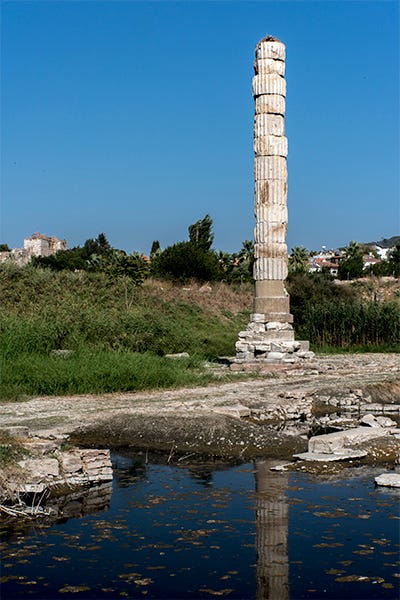
The Artemision of Ephesos was demolished; much later, remnant drums were piled up into one lone pillar
In 401 came the demolition of the great temple of Artemis at Ephesus, one of the Seven Wonders of the ancient Mediterranean. John Chrysostom, the patriarch of Constantinople, had its fine marbles burned to produce lime for cement, and robbed its great stones to construct other buildings. Around the same time, monks were pillaging temples in the hills of Lebanon. Some of them were killed by the outraged peasantry. [Chuvin, 75; “The Destruction of Pagan Temples” ]
Another pagan stronghold was Gaza. When the bishop visited, the populace burned noxious substances and scattered thorns and garbage on the road before him. In 402 the bishop called in imperial troops to destroy the city's eight temples. [Chuvin, 77] He ordered their stones to be used to pave a highway, but pagans refused to walk on them. [Moore, 47] Gaza “long remained a pagan city,” keeping up old festivals such as the Rosalia. [Chuvin, 20, 78] The Brumalia festival was still being celebrated in the year 700. [MacMullen, 39]
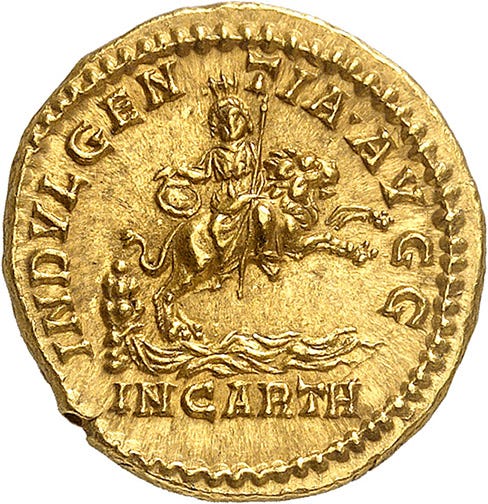
Juno Caelestis, great goddess of Carthage, riding a lion over the seas
In Tunisia, the temples of Carthage were destroyed in 399, all except the mile-long temple of Tanit Caelestis. The bishop of Carthage sat on the throne of Caelestis and declared that her temple was now a cathedral. But the pagans clung to a prophecy that the goddess would restore her temple. Augustine marveled, “How great was the power of the goddess Caelestis in Carthage!” [Chuvin, 73] The people revered her as the “Lady,” “Most Holy,” “Eternal,” “Mother of Heaven.”
“How great was the power of the goddess Caelestis in Carthage!” —Augustine bishop of Hippo, Algeria
It proved impossible to convert this goddess temple to a cathedral. The bishop discovered that large numbers of those attending church services had actually come there to worship Caelestis, as Salvian of Marseilles relates. So in 421 the bishop finally ordered the building to be razed, a task that could only be accomplished by calling in armed imperial troops to quell popular resistance. [Chuvin, 73-5; Smith 1976: 229; MacMullen, 25; 53; 176 n. 83.]
Egyptians mounted the stiffest resistance to the Roman edicts. They fought bloody street battles to defend the temples of Alexandria against mobs led by bishop Theophilus. The greatest was the battle for the Serapeum, whose defenders held out for three years. In 391 soldiers read an imperial order for its destruction but, still fearing divine retribution, they hesitated to begin demolition. Their commanders prevailed and the Serapium was razed, but only after stiff opposition.
The pagan Eunapius raged against “the abominable ones” who destroyed the temples and stole the statues and offerings. “For among them, every man is given the power of a tyrant who has a black robe and is prepared to behave badly in public.” He wrote that only the floors of the Serapeum remained, because the stones were too heavy to move. [Eunapius, 421-3; Smith 1976: 170-73] Monks took over the temple ruins to prevent people from worshipping there.
One of the defenders of the Serapeum was Antoninus, son of the philosopher and seeress Sosipatra of Pergamum, in northwest Anatolia. He “foretold to all his followers that after his death the temple would cease to be, and even the great and holy temples of Serapis would pass into formless darkness and be transformed, and that a fabulous and unseemly gloom would hold sway over the fairest things on earth.” [Eunapius, 416-7]
©2025 Max Dashu. Part III coming soon. As always, bibliography will be published after I’ve completed all chapters.
https://doi.org/10.12681/DIA.41703
Goddess worship subsumed in inventing Mary, a virgin mother not a threat to church power.